Autism
Definitions, Research, and Perspectives
Reading time: 12 to 14 minutes
At first glance, this word may raise questions: What is this disorder often called Autism Spectrum Disorder (ASD)? What is its origin and how has research on it developed? Understanding its history and the studies surrounding it is essential to better grasp the reality of those affected.
This article is for informational purposes only and is not intended to provide a diagnosis. If you recognise yourself in some of the symptoms described, please speak to a psychiatrist for a proper diagnosis.
Eugen Bleuler and the Origins of the Term "Autism"
To understand this disorder, it is important to go back to the earliest research. The term "autism" was first defined in 1911.
“The term "autism" was first defined in 1911 by Eugen Bleuler, who used it to describe a particular attitude observed in young adults with schizophrenia.”
Before tracing its history, it is helpful to clarify its current definition. According to the World Health Organization (WHO), it is a neurological disorder affecting brain development. There are several types of autism, hence the name “spectrum disorder”. Due to its complexity and variations, this disability can be difficult to detect, especially in children. Some people show similarities to autism without a confirmed diagnosis being possible.
In 1911, researcher Eugen Bleuler used the term "autism" for the first time in his book Dementia praecox oder Gruppe der Schizophrenien (Early Dementia or the Group of Schizophrenias). He used it to describe a distinctive attitude observed in young adults with schizophrenia. At that time, it served to isolate and designate a particular attitude in schizophrenic young adults. But why this usage? We will explore that shortly. According to Bleuler, autism was close to what he called “auto-erotism”, an outdated term referring to withdrawal into oneself. This term had been defined by another researcher in 1905 in his book Drei Abhandlungen zur Sexualtheorie (Three Essays on the Theory of Sexuality). Bleuler explained that he wanted to distance himself from Freud’s reference to an expanded concept of sexuality that “could lead to many misunderstandings”. Another term was also created at that time: schizophrenia, used in the plural as it referred to a “group of schizophrenias”, aiming to evolve the concept previously used for early dementia.
By 1911, the notion of autism had evolved significantly, leading to the need to clearly identify the childhood disorder. Swiss psychiatrist Adolf Meyer, future director of Leo Kanner, proposed an interpretation linked to psychic mechanics, mentioning a “destruction of naïveté”.
We can note the evolution between Bleuler and Meyer; with the latter, the disorder comes closer to what we know today.
Autism is increasingly seen as a psychological disorder, although it was only recognised much later as such and as a genuine disability.
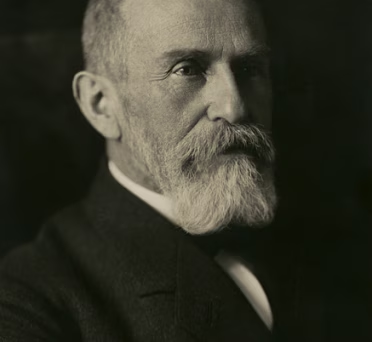
Eugen Bleuler
Towards an Understanding of Autism in Children
But the history of autism research does not stop there: let us jump forward a few years to discover what comes next. In 1923, the focus was on a loss of contact with reality. Researcher Eugène Minkowski, former assistant to Bleuler (who coined the term), echoed this in his book La Schizophrénie. It is worth noting that the disorder was initially seen as an offshoot of schizophrenia; although the two are now separate, they were not at the beginning of research.
In 1930, a woman advanced the question of what autism is. Melanie Klein spoke of childhood schizophrenia to describe children who, in her view, lacked affective contact. She was the first to publish two descriptions of what might characterise this disorder.
For now, everything is still somewhat vague and lacks a true description beyond conceptual ideas as seen previously.
This conception would later be identified as Kanner’s autism. Lauretta Bender proposed a separation between childhood schizophrenia and autism. She explained that the biological process is broadly the same but does not have the same effect on a mature brain as on an immature one. In doing so, she absolved mothers, who until then had been held responsible for the disorder, stating that the family environment was not decisive. We can see this notion of maternal responsibility in the series Astrid et Raphaëlle (released 19 April 2019), in season 1 episode 7 “La mort et compagnie”, where Mathild Nielsen confesses to Raphaëlle the reason for leaving her autistic daughter Astrid.
Even before Kanner and Asperger, Dutch psychologist Ide Freye had already mentioned the term “autism” as early as 1937 while studying children with severe developmental disorders alongside psychologist Chorus. She proposed a classification of psychological disorders in children that included autism. This advance was significant, as a combination of orthopedagogy and psychotherapy was already being suggested at the time.

Astrid Nielsen, from Astrid et Raphaëlle
Kanner and Early Infantile Autism
We are now in 1943. Psychiatrist Leo Kanner defined a clinical picture of an “autistic disturbance of affective
contact”. It was first used as an adjective describing an “autistic disturbance of affective contact”, later
called "early
infantile autism". This is where we see a difference between Bleuler’s initial 1905 definition and
Kanner’s. For Bleuler, autism was a symptom of schizophrenia, whereas Kanner viewed it as a distinct
disorder. This marked the clear separation between schizophrenia and autism. To support his idea, Kanner
studied 11 children, including Donald Triplett, followed for 5 years and designated as case no. 1. During
his study, Kanner noted that all these children shared specific common traits:
- Difficulty establishing affective contact (emotional relationships).
- Intense interest in repetitive activities.
- Need for routines.
- Strong intellectual abilities in certain areas.
From this observation came the conclusion that it was not a psychosis but a distinct developmental disorder. Meanwhile, on 8 October 1943 in Vienna, Austria, Austrian physician Hans Asperger studied four children he called his “little professors”. These observations were made under the Nazi regime with which he collaborated. The observations were written in German and first translated into English in 1971. It was in 1981 that these writings truly gained recognition, thanks to Lorna Wing, who based her research on them. These works became known as Asperger’s syndrome. Note that Asperger’s syndrome and Kanner’s syndrome are no longer used today, partly due to advances in research and partly because of Asperger’s collaboration with the Nazis and the treatment his “little professors” received.
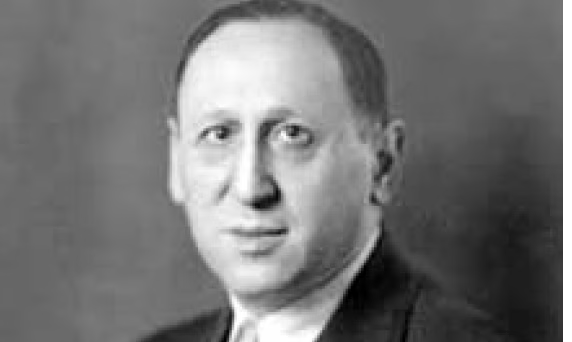
Leo Kanner
The Birth of the Autism Spectrum
However, by 1990, differences were observed: some autistic people manage to live independently, have social
lives, and even pursue studies or work. This observation led to distinguishing several aspects of autism,
separating “severe” autism from what was termed “high-functioning autism”. One might then ask: how
do we determine if someone is affected by autism? From this point, we began to speak of an autism spectrum—a single
large family of disorders that manifest to varying degrees, as there are many different forms. Autistic
people can experience very diverse situations:
- Some require constant support, while others are more independent.
- Some have mild social difficulties, others more significant ones.
- Abilities and interests also vary greatly from person to person.
In addition to differences in social interaction or communication, some autistic people develop what are known as special interests. These intense passions for a particular subject—such as animals, music, or numbers—can play a major role in their lives.
These highly focused interests are often a source of joy, calm, and motivation, and can even become an asset in their educational or professional journey.
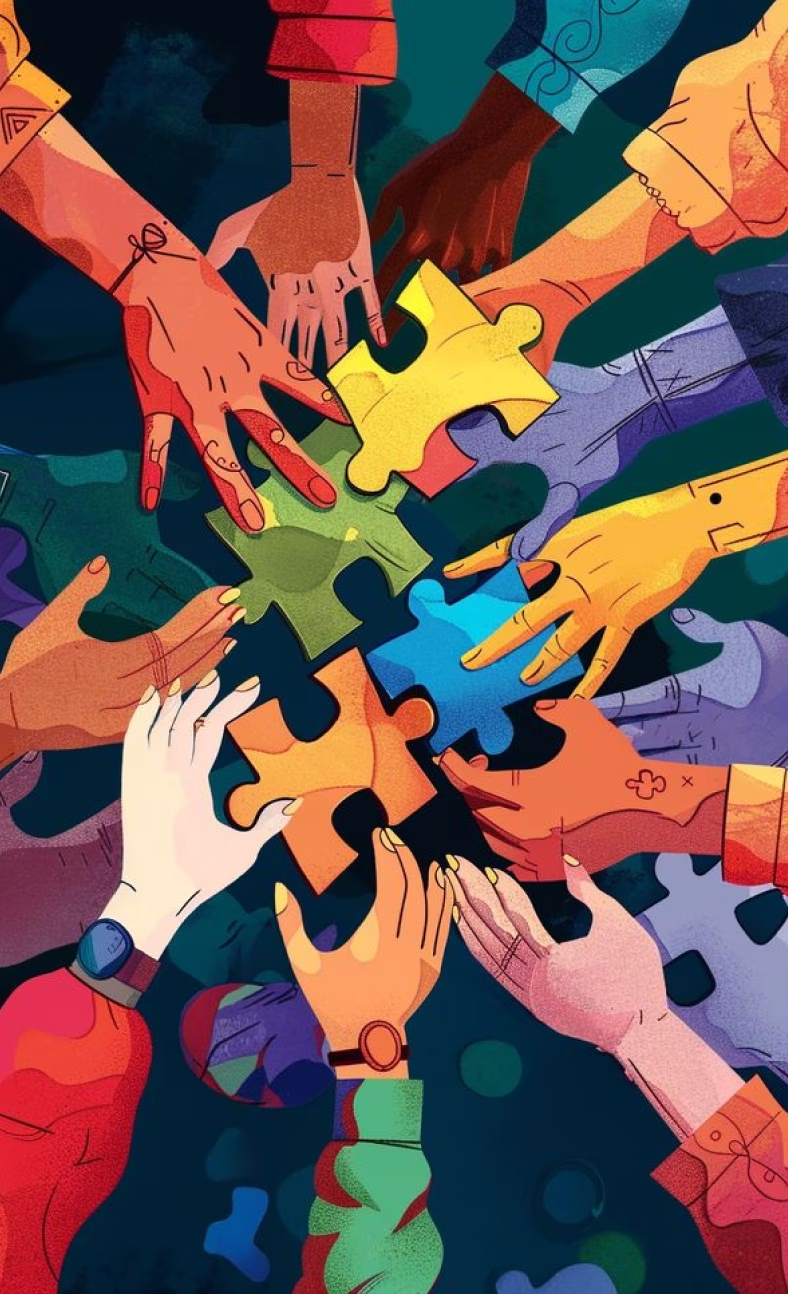
For example, in the series Astrid et Raphaëlle mentioned earlier, one of the protagonists with autism has a special interest in puzzles. Another character, William, is passionate about trains. In Astrid’s case, this interest drives her to participate in investigations, as shown in the series aired on France TV.
This diversity led to the concept of Autism Spectrum Disorder (ASD), a term that gradually became widespread. Finally, in 2010, autism was linked to a neurological disorder in the early stages of brain development. In particular, a defect in nerve cells at the level of synapses was identified. This defect may be hereditary and linked to certain combinations of common genetic factors. This supports the idea that autism can be genetically transmitted.
Today, research continues to evolve, as the autism spectrum encompasses highly varied and sometimes still poorly understood forms.
Some people still cannot know with certainty whether they are affected. Furthermore, several concepts are now debated, including the term “high-functioning autism”, which does not always reflect the real daily challenges these individuals face. In the next article, we will explore how the work of researchers like Lorna Wing helped rethink autism through the concept of a spectrum.
William Thomas, from Astrid et Raphaëlle
Other Articles