Popularizing Science
The Work of Lorna Wing
Reading time: 6 minutes
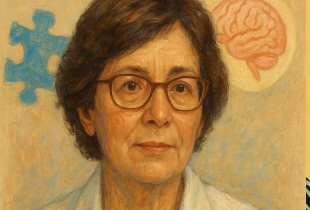
Lorna Wing, a renowned British psychiatrist although little known outside the autistic community, greatly contributed to highlighting the current definition of what autism is. In this article, we will examine the concrete role she played in research, as well as her work in detail.
To put it in context, Lorna Wing was the mother of an autistic child, Susie, who greatly influenced her research. She was born on 7 October 1928 and passed away on 6 June 2014. She already had a background focused on child psychiatry. Families were therefore stigmatised, which prompted Lorna to become involved in this cause.
Her research truly began in 1964, when she published Autistic Children (original title).
Two years earlier, she had participated in the creation of the National Autistic Society in 1962, the first major British association dedicated to autism, thus demonstrating her early commitment to the cause. Before its creation, support for families of autistic people was not the same due to lack of knowledge and was still largely confused with childhood schizophrenia. It can be estimated that by 1972, between 10,000 and 50,000 copies of her book had been sold worldwide, including translations. Lorna Wing collaborated for the first time in depth with psychologist Judith Gould at the Camberwell Clinic between 1977 and 1979.
This collaboration was based on a hospital and 91 children, which later helped define the future criteria of Wing’s Triad (Triad of Impairments). She defended the idea that understanding autistic people required listening to their experiences, emotions, and ways of thinking.
She thus opposed a purely medical or pathological view of autism.
This is a foundational model for the future definition of the autism spectrum that she would later
popularise. It highlighted that the difficulties faced by autistic people did not stem from an isolated
deficit, but from a set of interactions between social aspects, communication, and adaptive behaviours.
Lorna and Judith concluded that the autism spectrum was characterised by:
- A difference in social understanding rather than total disinterest.
- Communication that exists but is different in form.
- Routines that these people have are not to be corrected but are an adaptation strategy in an unpredictable
world.
In 1981, Lorna revisited Hans Asperger’s work by proposing the concept of a spectrum rather than a syndrome, as it is very difficult to define autism precisely due to its complexity and variations. She also brought her predecessor’s work to international attention, which until then was only known in Austria. The British psychiatrist thus positioned it in classifications relative to the autism described by Kanner.
In continuity, in 1982, she wrote that she had opened a Pandora’s box by presenting Asperger’s syndrome.
She continued to describe other forms of autism that were still unrecognised at the time. The following year,
in collaboration with E. Burgoine, she presented three more recurrent characteristics in Asperger’s
autism:
- Deficits in social interaction / non-verbal communication
- Restricted interests or intense absorption in certain subjects
- Motor clumsiness or unusual coordination and postures
This synthesis was only disseminated in the 1990s, and she reused the title for one of her books published in
2011, Brain research: a personal view.
In 2006, a collective work on autism as a neurological disorder in the early stages of brain development was
published under the direction of Roberto Tuchman and Isabelle Rapin for the International Child Neurology
Association. It reports on the latest discoveries about autism as well as the advances she made. This
article also confirms the British researcher’s theories: it is indeed a spectrum of neurodevelopmental
conditions.
It can also be noted that the article highlights the role of multiple factors (genetic, environmental, developmental), which complements Wing’s view that autism was multifactorial.
Her research profoundly influenced how international institutions, such as the World Health Organization (WHO) and the American Psychiatric Association (APA), revised their diagnostic criteria. The DSM and ICD classifications gradually incorporated her conclusions. Lorna Wing greatly contributed to advancing the understanding of autism through her research. Despite the evolution of the name, with the removal of the term Asperger’s Syndrome in favour of Autism Spectrum Disorder or ASD, the British researcher remains little known, and it was only in 2013 that the change was officially adopted.
By seeking to better understand autism, Lorna Wing also helped change the way people view those affected. Her caring and open approach helped break decades of stigmatisation, reminding us that scientific understanding must always be accompanied by empathy and listening.
Other Articles