Autism in Culture and Media
How the Media Represents Autism
Reading time: 4 to 5 minutes
How are autistic people perceived, and how were they perceived in culture? Why does difference still cause so many misunderstandings? The media, whose main role is to influence the viewer, often tailor their content to the dominant ideas and values of their time. Thus, throughout history, the representation of autism in culture and media has evolved significantly, reflecting the mindsets and prejudices of each era.
Often Stereotypical Representation
You probably picture a gifted individual who prefers to be alone, or think the disorder comes from upbringing? But why is this image so entrenched? In the 1990s and 2000s, it was widely promoted, especially with the release of the film Rain Man in 1988. Dustin Hoffman plays a savant character with extraordinary calculation abilities but emotionally detached from the world.
The film grossed $239.97 million internationally.
It therefore had a huge impact but also distorted the perception of autism at the time. Indeed, it trapped those affected in stereotypes, preventing visibility of the real, multifaceted nature of autism. Years before the film’s release, in 1976, Lorna Wing redefined autism as a spectrum called Autism Spectrum Disorder (ASD). At that time, people on the spectrum were often portrayed as white men with high intellect, rendering women, racialized individuals, and non-verbal people invisible.

Dustin Hoffman, Rain Man
An Evolution
The emergence of the “neurodiversity” concept in the 1990s profoundly changed the perception of autism. Rather than viewing autism as a defect to correct, this movement promotes recognition of the diversity of neurological functioning. It has inspired newer, more human and respectful representations, highlighting the skills, creativity, and sensitivity of autistic people.
In recent years, we can observe an evolution in the representation of these individuals in the media. On Netflix, for example, many films and series address the topic by valuing their unique traits and strengths. The Good Doctor (2018) features a doctor on the spectrum overcoming social difficulties while showcasing his talent. In 2022, South Korea released Extraordinary Attorney Woo, portraying a woman with autism in a respectful and sensitive way. This type of content remains rare.
At the same time, various documentaries, particularly on France TV or Arte, present portraits or scientific testimonies, enriching public understanding. This shift can also be seen in modern productions like Atypical (2017), which follows the daily life of an autistic teenager seeking independence and self-understanding. Unlike older representations, the series shows everyday life, relationships, mistakes, tenderness, and humor. The 2023 German film Afire (Roter Himmel) is another excellent example of evolving attitudes. Autism is no longer seen by many as something negative, but rather as a source of inspiration.
Director Christian Petzold even revealed that he drew inspiration from autistic behaviors to add nuance to his main character.

Woo Young-woo, Extraordinary Attorney Woo
A Media Revolution
With the rise of social media platforms like Instagram, TikTok, and YouTube, the image of autism is now partly shaped by those who live it daily. Through personal testimonies and advocacy, creators such as Hugo Horiot, Alexandra Duvivier, and Yo Samdy Sam share their experiences and struggles. This personal expression offers a more authentic view, free from scripted portrayals in television or films.
The hashtag #ActuallyAutistic has been used in nearly 6,515,470 posts on X (formerly Twitter), many from autistic people with or without an official diagnosis.
This movement has helped amplify their voices, allowing people to express themselves freely away from stereotypes and labels imposed by the media.
Today, these new representations contribute to a better understanding of autism, although much progress remains to be made. The media still tend to highlight certain profiles—often male and high-potential—while neglecting more ordinary realities and daily challenges. The growing plurality of voices, especially through social networks, plays a crucial role in continuing to dismantle clichés and normalize difference.
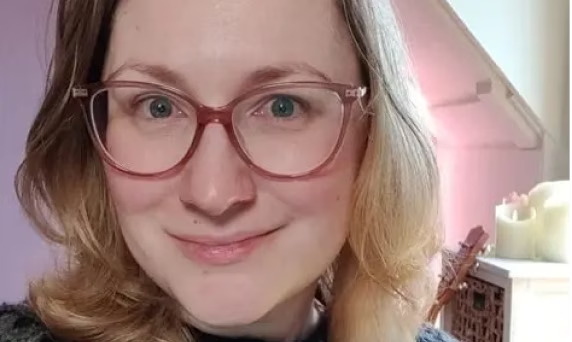
Yo Samdy Sam, content creator
Other Articles