The Matilda Effect
Forgotten Women in Science
Reading time: 4 minutes
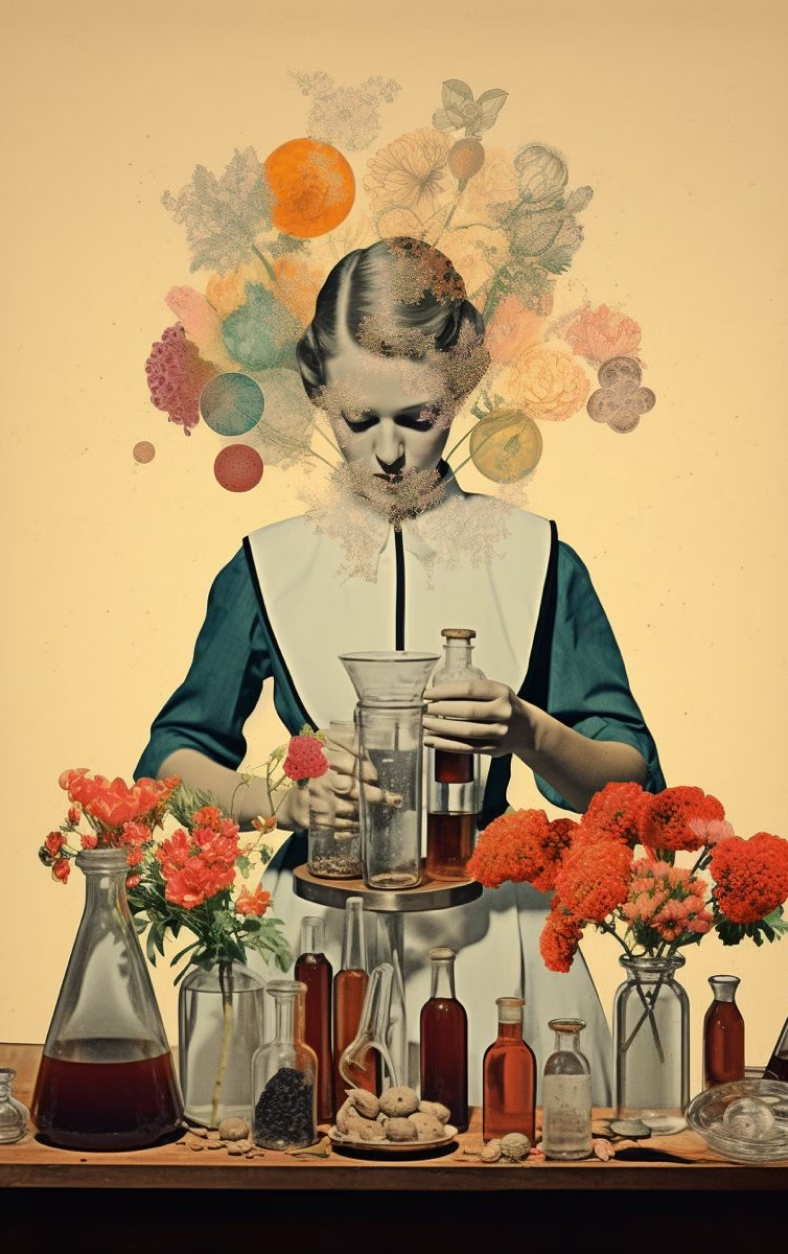
The Matilda Effect? What is it? Is it named after a woman? Why is it important to talk about it? According to Wikipedia, the Matilda Effect is the systematic denial, appropriation, or minimisation of women’s contributions to scientific research, whose work is often attributed to their male colleagues.
Origin
This phenomenon was first mentioned in 1870 on pamphlets in an essay by suffragette and abolitionist Matilda Joslyn Gage (1826–1898). It was later published in 1883 in an article in the North American Review. The term itself was officially coined in 1993 by science historian Margaret W. Rossiter.
The Matilda Effect denounces the appropriation by men of their female colleagues’ scientific work. They are thus unjustly credited for a discovery that does not belong to them.
This phenomenon is compared to the Matthew Effect, which is based on seniority: an eminent scientist often receives more credit than a relatively unknown researcher, even if their work is similar or shared.
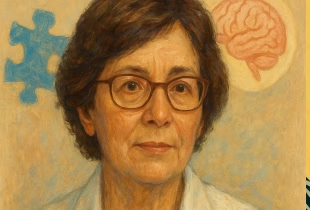
While studying the Matthew Effect, the historian noticed that it occurred more and more frequently, particularly against women. She therefore named her theory the Matilda Effect in homage to the American suffragette Matilda Joslyn Gage. It also occurs when a woman makes a discovery at the same time as a male colleague: often only his name is remembered.
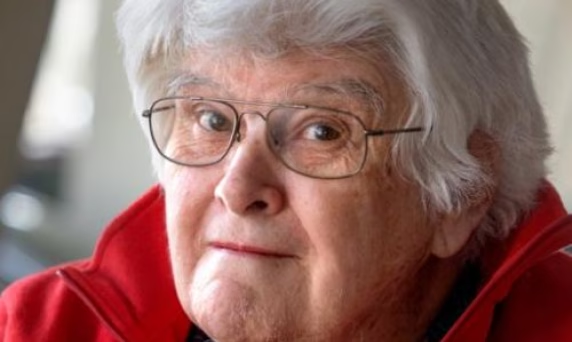
Margaret W. Rossiter
Examples
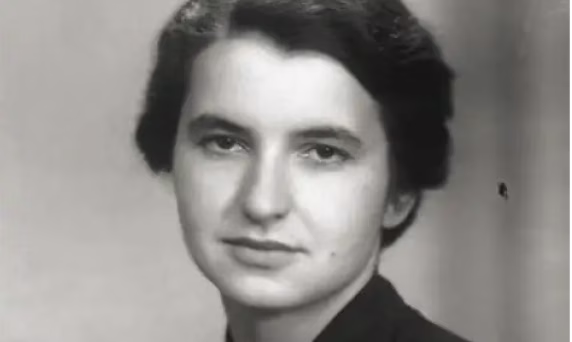
We can cite two famous names who suffered from this effect, but in reality many more women have experienced it. Sometimes their work was recognised later and they received awards, but very often nothing was done to correct the error. Rosalind Franklin (1920–1958) discovered the structure of DNA, yet recognition went to her colleagues Watson and Crick. Another sadly famous case is that of Lise Meitner (1878–1968), a researcher who discovered nuclear fission. The Nobel Prize for this discovery was awarded to her male colleague.
Today, we are aware of this problem and are trying to pay tribute to them through documentaries or posthumous nominations, particularly for the examples mentioned above.
They are now recognised worldwide as the true owners of these discoveries. We can also mention Maryam Mirzakhani, the first woman to receive the Fields Medal in mathematics in 2014. Although her award came late, it was widely publicised to highlight the importance of women in science who have been overlooked for too long. We can note this strong desire, which has gained popularity in recent years, to give them what is rightfully theirs.
Recognising these past injustices is essential to encourage more equitable science and highlight female talent that is still too often ignored.
In Culture and Media
In recent years, several cultural works have sought to rehabilitate these forgotten figures. The film Hidden Figures (2016) highlights three African-American NASA mathematicians who long remained in the shadow of their male colleagues. Similarly, documentary series such as Genius or Les Pionnières de la Science give a voice back to these invisibilised women. Despite the progress made, inequalities persist.
According to a UNESCO report, women still represent only about 30% of researchers worldwide.
They also receive less funding for their projects and are cited less often in scientific articles. Since the creation of the Nobel Prizes in 1901, only 61 women have been laureates (across all scientific and literary prizes) out of more than 900 recipients.
This erasure of women is not just a matter of scientific recognition; it is part of a society that values men’s work more highly. Recognising these past injustices is essential to encourage more equitable science and highlight female talent that is still too often ignored. This is why 11 February was created as the International Day of Women and Girls in Science, and 8 March (International Women’s Day) focuses more broadly on women. The Matilda Effect is not limited to Western countries. Around the world, many female researchers have seen their work minimised or attributed to others. In Africa, Asia, and Latin America, more and more programmes are now seeking to document and value these journeys.
Other Articles